27 August 2010
Probing the core of distant stars…
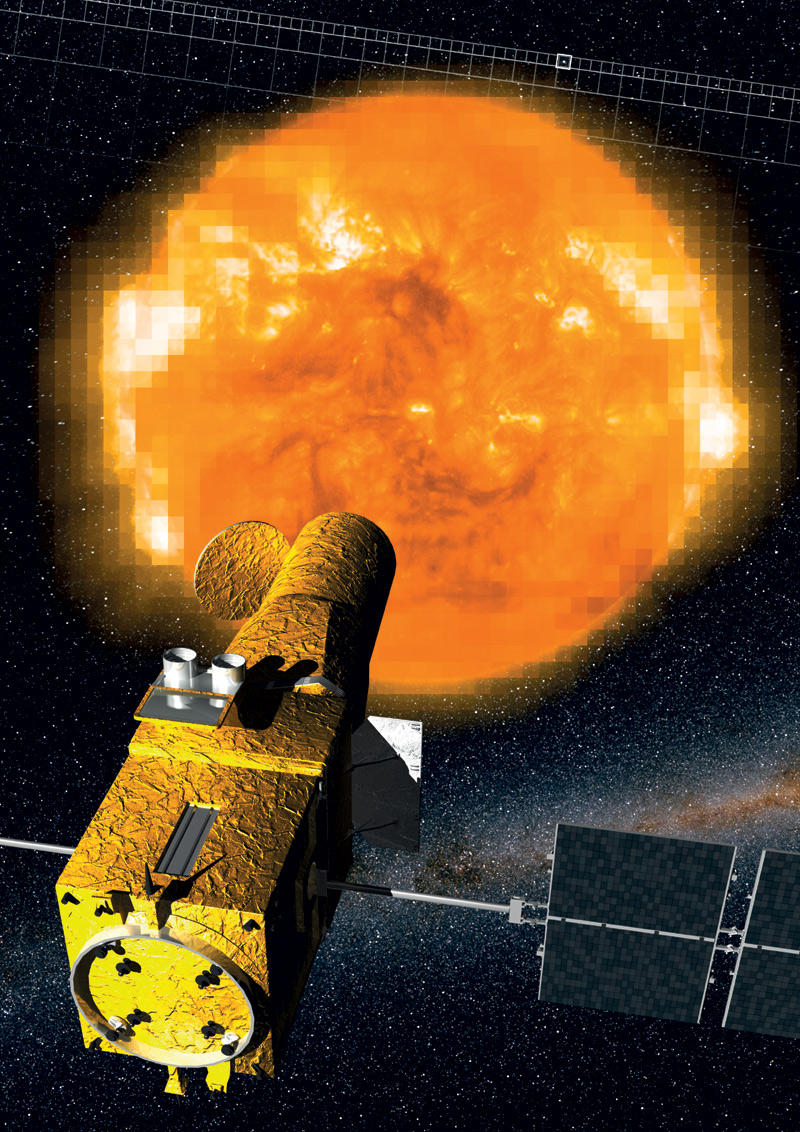
The star that’s got everybody talking is in the Unicorn constellation, east of Orion. So what makes this star so special? It’s just like our Sun, or at least it vibrates in a similar way. Every star has its own modes of oscillation that allow scientists to deduce what’s going on inside the core.
CNES’s CoRoT satellite is capable of detecting the tiniest variations in starlight, as faint as only 1/10,000th of a star’s brightness. That kind of sensitivity makes it possible to open up the inner structure and processes of very distant stars.
“This asteroseismology technique is also widely used to study the Sun: by looking at seismic variations, we can deduce for example the size and rotation velocity of its layers to gain a closer insight into solar cycle variations,” explains Olivier La Marle, in charge of astrophysics programmes at CNES.
Using data from CoRoT, an international team of researchers from the French atomic energy agency CEA, the Observatoire de Midi-Pyrénées and the Observatoire de Paris has studied the activity of a star 100 light years away for the first time. The results of their research published in Science reveal a stellar activity cycle analogous to that of the Sun.
… to learn more about the Sun
The cycle of a star, during which its inner structure changes, is directly related to its magnetic activity. But researchers still have much to learn about the underlying mechanisms driving this process.
“For the Sun, we have solid hypotheses; in particular, we think that magnetic activity is linked to rotation of the Sun’s core, but we lack data to refine this theory,” says Olivier La Marle.
"Now that we know we can study stellar cycles and magnetic activity by measuring their brightness variations, we are going to be able to look at the light profile of hundreds of stars, refine our models and gain new insights in this area.” And CoRoT will be supported by the Kepler satellite in this quest.
The other challenge is to better understand how solar activity affects Earth’s climate and to improve forecasting of the solar cycle and geomagnetic storms, which can massively disrupt power and communication networks.


